Hypotonic, isotonic or hypertonic? What really happens inside your body
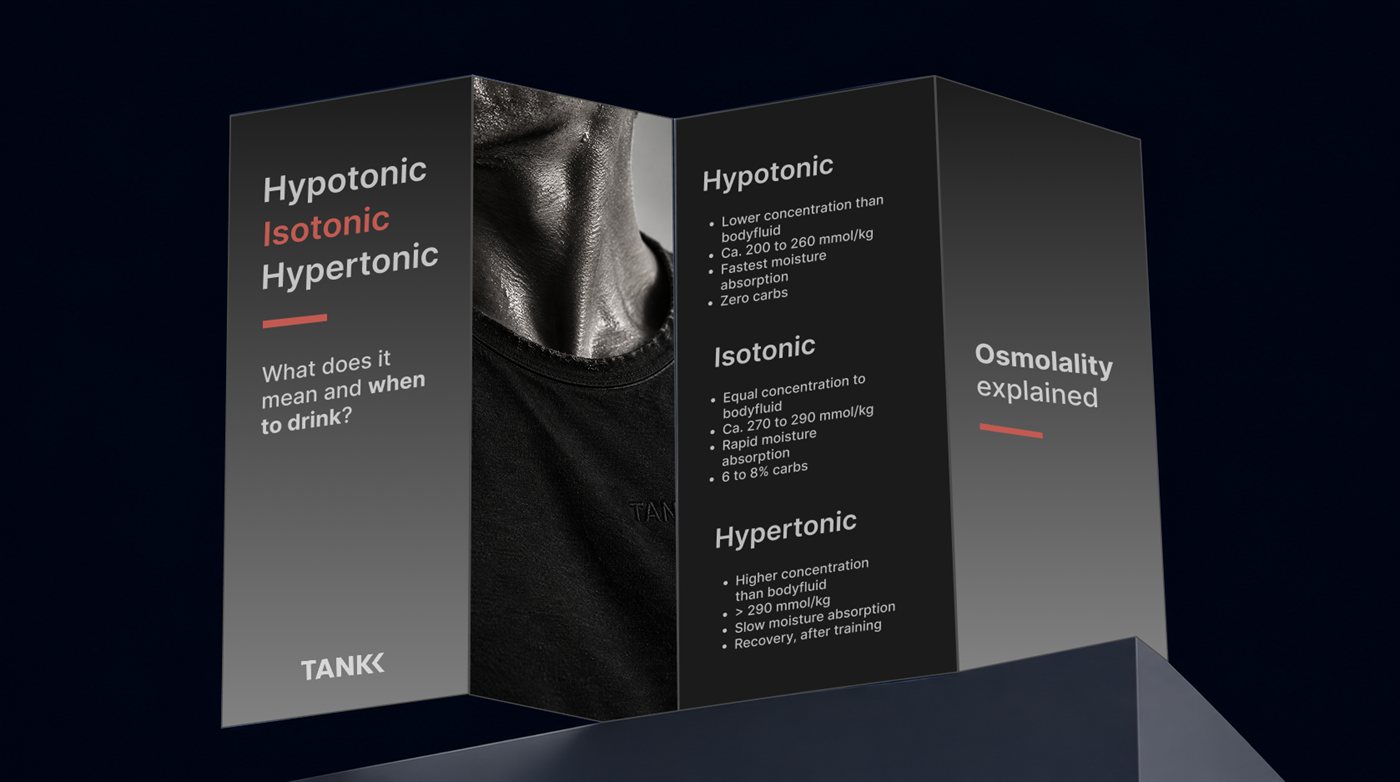
Isotonic. Hypotonic. Hypertonic. It sounds as if it describes how strong the flavour is, or how much sugar is inside. It doesn't. It describes how many particles are floating in the liquid, and that single fact decides whether water moves from your gut into your blood or gets pulled back out of it.
This article explains what the three types actually mean, how quickly each one is absorbed, when to use which, and why 93% of the sports drinks on the shelf don't even give you that information.
It all starts with osmolality
Osmolality is simply the number of dissolved particles per kilogram of fluid: salts, sugars, amino acids. Water always moves towards the side with the highest concentration of particles, to even out the difference. That is the whole mechanism.
Your small intestine has its own concentration, and that is the benchmark for everything you drink: the contents of the small intestine sit at around 270 to 290 mmol per kilogram. Compare your drink with that figure and you know which way the water will move.
Worth knowing, because the industry is sloppy about it: there is no official, legally defined threshold that says from which number something counts as hypotonic or hypertonic. What does exist are three hard reference points. Intestinal contents at 270 to 290 mmol/kg. The European window for drinks allowed to claim they enhance water absorption: 200 to 330 mOsm/kg. And the threshold above which gastric emptying starts to slow down: roughly 350 mOsm/kg. Work with those three and you will always be on solid ground.
Hypotonic: water into your blood, faster
A hypotonic drink contains fewer particles than your body fluids, somewhere around 200 to 260 mmol/kg. That difference in concentration actively draws the water towards your blood. The research is clear on this: hypotonic solutions in that range are absorbed noticeably faster by the small intestine than isotonic ones.
The trade-off: there are few carbohydrates in it, so you take in hardly any fuel. That isn't a shortcoming, it's the point. You drink hypotonic because you want fluid and electrolytes, and you want them fast.
When: short to medium-length sessions, anything under an hour, strength training with long rest periods, hot gyms, and whenever you're simply thirsty. Also beforehand, so you start a session well hydrated.
Isotonic: fluid and fuel at the same time
Isotonic means the same particle concentration as your body fluids, so around that 270 to 290 mmol/kg. Water and dissolved substances move in balance, and you get fluid and carbohydrates in a single sip.
This is where the most interesting bit of physiology in the whole story sits. Isotonic sports drinks almost always contain 6 to 8% carbohydrates, and that is not a marketing decision. It is the highest percentage at which your stomach still empties at full speed. Below 6% there is no meaningful slowdown in gastric motility. Go above it and net fluid delivery drops: you take in more sugar but less fluid. At the same time, 6 to 8% delivers exactly the 30 to 60 grams of carbohydrates per hour that the International Society of Sports Nutrition recommends during exercise, taken in small amounts every 10 to 15 minutes.
In other words, 6 to 8% is the point where fluid absorption and fuel supply peak together. That is also why isotonic is the largest segment of the European sports drink market, with a 54% market share.
When: sessions longer than an hour, hard intervals, ninety minutes of padel or squash, spinning, HYROX, long high-volume strength sessions. Start early. Fall behind on drinking during a long session and you won't catch up.
Hypertonic: more fuel, slower fluid
A hypertonic drink is more concentrated than your body fluids. The result is counter-intuitive: instead of releasing water into your blood, a drink like this pulls water into the gut to dilute itself. Your fluid absorption slows down, and above roughly 350 mOsm/kg your gastric emptying starts working against you too.
That makes hypertonic a poor choice in the middle of a hard, hot session where dehydration is your biggest problem. And a good choice when fluid isn't the priority but energy and recovery are: after training, or during long, light efforts where topping up carbohydrates matters most.
When: after training as part of your recovery, or during long endurance efforts where you need more carbohydrates per sip than an isotonic drink can provide.
At a glance
| Concentration | Fluid absorption | Carbohydrates | When | |
|---|---|---|---|---|
| Hypotonic | Lower than body fluids, approx. 200 to 260 mmol/kg | Fastest | Low | Under an hour, strength training, hot gym, beforehand |
| Isotonic | Equal, 270 to 290 mmol/kg | Fast | 6 to 8%, 30 to 60 g per hour | Over an hour, intervals, competition |
| Hypertonic | Higher than body fluids | Slowest, draws water into the gut | Highest | After training, recovery, long light efforts |
So when do you just need water?
More often than a sports drink brand will tell you. The National Athletic Trainers' Association is explicit about it: if you're active for less than an hour, water is all you need. Only beyond the hour, or with intense intervals, do carbohydrates and electrolytes start earning their place.
A TANKK can also dispense plain water, although the club decides whether a machine is set up that way and at what price. The point isn't that you always need a sports drink. The point is that you know the difference.
There is one argument that still holds under the hour, and it isn't a marketing one: taste determines how much you drink. Give someone a flavoured, lightly sweetened drink and they will naturally drink more than someone given plain water. In the classic study with young athletes, fluid intake was highest with a flavoured carbohydrate-electrolyte drink, followed by flavoured water, and lowest with unflavoured water. On plain water they became mildly dehydrated; with flavour they didn't. Drinking it cool helps as well: people prefer to drink at around 15 degrees.
So dehydration under the hour is rarely about which drink you need, but about how much you actually get down. If lemon, blueberry, cactus or watermelon means your bottle ends up empty rather than going back into your bag half full, that is the real benefit of sports water in a short session.
What happens when you don't drink enough
The numbers are sharper than most athletes think. Performance consistently drops once you lose 2% of your body weight in fluid. For someone weighing 80 kilos that is 1.6 litres, and you can easily hit that in one hard session.
In a meta-analysis on dehydration and performance, muscle strength fell by an average of 5.5% and muscular endurance by 8.3%. In a controlled study using a full-body strength protocol, dehydrated participants completed 144 repetitions in total, compared with 169 for the same men when hydrated. That is roughly 15% of your session gone. And it felt harder too: session RPE rose from 7.4 to 8.6.
So you haven't got weaker. You've got drier.
Your brain notices even before your muscles do. Once you lose more than 1% of your body weight, attention, reaction time and short-term memory already deteriorate. Beyond 2%, that effect becomes clearly larger.
How much do you actually lose?
Between 0.5 and 4.0 litres of sweat per hour, depending on the person, the intensity and the temperature. There are figures per sport: endurance athletes average 1.28 litres per hour, basketball players 0.95, footballers 0.94.
For the gym floor, that figure doesn't exist. There has simply never been any proper research into sweat loss during indoor strength training, which mainly shows how little attention hydration gets in the gym.
And sweat isn't just water. The sodium concentration in sweat ranges from 230 to 2300 milligrams per litre. That is a tenfold difference between two people standing side by side at the same rack. If you see white salt marks on your shirt as it dries, you're at the high end and you need more sodium than the person next to you, not more water.
The simplest test already exists: weigh yourself once before and after a hard session, in dry clothing. Every kilo you've lost is roughly a litre of fluid. If you need to perform again within four hours, drink about 150% of what you lost, because you keep losing fluid through your urine while you rehydrate.
The question to ask of every sports drink
To be allowed to claim in the European Union that a drink "enhances the absorption of water during physical exercise", it has to meet strict conditions: 460 to 1150 milligrams of sodium per litre, an osmolality between 200 and 330 mOsm/kg, 80 to 350 kcal per litre from carbohydrates, and at least 75% of that energy from high-glycaemic carbohydrates.
In a 2024 analysis of commercial sports drinks, only 57.6% met the sodium requirement. And 93.2% didn't state the osmolality on the label at all.
So you're standing in front of a shelf full of drinks that won't tell you what they are. The question is simple: how much sodium per litre, and what osmolality? If a brand can't answer that, it's selling you a flavour, not a sports drink.
How TANKK solves this
TANKK is the only machine that serves hypotonic, isotonic and hypertonic sports water from the same tap. You choose the tonicity that suits your session, the flavour you want (lemon, blueberry, cactus or watermelon) and whether to add caffeine. A machine can also dispense plain water; whether that option is switched on, and at what price, is up to the club.
Every fill is freshly mixed in the machine, with electrolytes (sodium, potassium, calcium, magnesium) and vitamin C. No bottle that has been sitting in a fridge since Tuesday, no label that leaves out half the story.
Sources
- Intestinal contents 270 to 290 mmol/kg, gastric emptying slows from approx. 350 mOsm/kg, faster hypotonic absorption, hypertonic reverses water flux, carbohydrates above 6% reduce fluid delivery: Pérez-Castillo et al., "Compositional Aspects of Beverages Designed to Promote Hydration Before, During, and After Exercise", Nutrients 2024;16(1):17, https://www.mdpi.com/2072-6643/16/1/17
- European conditions for carbohydrate-electrolyte drinks (osmolality 200 to 330 mOsm/kg, sodium 460 to 1150 mg/L, 80 to 350 kcal/L): EU Register on nutrition and health claims, Regulation (EU) 432/2012, https://ec.europa.eu/food/food-feed-portal/backend/claims/files/euregister.pdf
- 57.6% meet the sodium requirement, 93.2% do not state osmolality: Martínez-Sanz et al., "Health Claims for Sports Drinks", Nutrients 2024;16(13):1980, https://www.mdpi.com/2072-6643/16/13/1980
- 30 to 60 g carbohydrates per hour in a 6 to 8% solution, every 10 to 15 minutes: Kerksick et al., ISSN position stand on nutrient timing, Journal of the International Society of Sports Nutrition 2017;14:33, https://link.springer.com/article/10.1186/s12970-017-0189-4
- 2% threshold, cognition above 1%, sweat loss 0.5 to 4.0 L/h, sweat sodium 230 to 2300 mg/L, water is enough under an hour, 150% of the fluid deficit: NATA, "Fluid Replacement for the Physically Active", Journal of Athletic Training 2017;52(9):877-895, https://www.nata.org/sites/default/files/2025-08/fluid_replacement_for_the_physically_active.pdf
- Flavour and sweetness increase voluntary fluid intake, flavoured carbohydrate-electrolyte drink above flavoured water above plain water, preferred temperature around 15 degrees: Baker, "The Fluid Replacement Process: Principles of Beverage Formulation for Athletes", Gatorade Sports Science Institute, citing Wilk and Bar-Or 1996 and Minehan et al. 2002, https://www.gssiweb.org/sports-science-exchange/article/the-fluid-replacement-process-principles-of-beverage-formulation-for-athletes
- Muscle strength -5.5%, muscular endurance -8.3%: Savoie et al., Sports Medicine 2015;45(8):1207-1227, https://link.springer.com/article/10.1007/s40279-015-0349-0
- 144 versus 169 repetitions, session RPE 8.6 versus 7.4: Kraft et al., European Journal of Applied Physiology 2010;109(2):259-267, https://link.springer.com/article/10.1007/s00421-009-1348-3
- Sweat rate by sport: Barnes et al., Journal of Sports Sciences 2019;37:2356-2366, https://www.gssiweb.org/research/article/normative-data-for-sweating-rate-sweat-sodium-concentration-and-sweat-sodium-loss-in-athletes-an-update-and-analysis-by-sport
- Isotonic 54.26% market share in Europe: Mordor Intelligence, Europe Sports Drink Market, June 2026, https://www.mordorintelligence.com/industry-reports/europe-sports-drink-market/market-size
Ask your club about TANKK, or see how the machine works at tankk.eu.